Selecting a reliable Bd-Ptau217 Assay takes more than comparing prices or advertised sensitivity. Plasma p-tau217 is an emerging biomarker used in Alzheimer’s disease research, but assay results can vary with antibodies, calibration, sample handling, and instrument settings. Small differences matter. A low sample volume may suit a busy laboratory, while stable controls and clear documentation can matter more during validation.
This guide examines seven assay options for global buyers in 2026, focusing on practical details rather than headline claims. It considers analytical performance, workflow requirements, available technical support, supply continuity, and compatibility with common laboratory platforms. Buyers should also check intended-use statements and regulatory status in their own markets. Research-use products are not automatically cleared for clinical diagnosis, and no blood test should be treated as a stand-alone assessment. That distinction matters.
A comparison can narrow the field, but it cannot replace local verification. Request current validation data, review lot-to-lot information, and confirm shipping conditions before ordering. Ask specific questions. Some product pages leave important details unclear, and that is worth noting rather than smoothing over. The best choice depends on the intended study, available equipment, and the evidence a laboratory can independently confirm. This shortlist is a starting point, not a final endorsement.
Understanding BD p-tau217 assays starts with knowing what they measure. These blood tests detect phosphorylated tau at position 217, a biomarker associated with Alzheimer’s-related brain changes. They can help clinicians assess risk and decide whether further evaluation is appropriate. They do not, by themselves, establish a diagnosis. The Alzheimer’s Association’s 2024 Facts and Figures report estimates that 6.9 million Americans aged 65 and older are living with Alzheimer’s dementia. The need for practical testing is real, but so is the need for careful interpretation.
Assays differ in antibodies, instruments, sample handling, and reporting thresholds. Results from different platforms may not be directly interchangeable. A 2025 Alzheimer’s Association clinical practice guideline sets minimum sensitivity and specificity criteria for blood tests used to triage or confirm Alzheimer’s pathology in specialized care. Buyers should check validation data against those intended-use criteria, as well as the tested population and specimen type. No assay is perfect. That distinction is easy to overlook.
Tips: Compare independent clinical validation, detection limits, and quality-control procedures before selection. Ask how results are interpreted alongside symptoms and other tests. A clear report matters. So does staff training. When reviewing global purchasing options, confirm local availability and technical support; a strong assay on paper may still be difficult to implement consistently.
Comparing pTau217 assays starts with the intended use, not the headline performance claim. Is the test designed for research, triage, or clinical decision support? These uses require different evidence. Check the specimen type, such as plasma or serum, and whether collection and storage instructions fit your workflow. Small differences in tube handling or freeze-thaw cycles can affect results. Details matter.
Review analytical sensitivity, measuring range, precision, and the rate of samples falling outside that range. Ask for repeatability data across operators, sites, and reagent lots. A strong number in one study may not transfer to another population. Compare validation cohorts, including age, kidney function, and relevant clinical groups. Cutoffs also need scrutiny: were they established against an appropriate reference method, and tested independently? Results from different assays should not be treated as interchangeable without evidence.
Practical fit counts, too. Check sample volume, turnaround time, instrument needs, quality controls, and the availability of technical support in your region. Request clear instructions for handling borderline or discordant results. A higher sensitivity figure is not automatically the better choice; I would weigh it against specificity and the consequences of false reassurance or unnecessary follow-up. The evidence can still be uneven. Note what remains unvalidated, and revisit that gap before purchase.
For global buyers, seven leading blood-based pTau217 assay approaches are best compared by intended use, sample handling, and evidence—not by a universal ranking. Options include automated chemiluminescent immunoassays, electrochemiluminescent assays, digital single-molecule assays, bead-based immunoassays, immunoprecipitation–mass spectrometry, targeted LC-MS/MS, and multiplex panels. These methods differ in sensitivity, workflow, equipment needs, and susceptibility to sample variation. A result from one platform may not match another.
Look beyond a headline detection limit. Review validation data for the intended population, specimen type, and clinical setting. Check how the assay handles hemolysis, storage time, freeze-thaw cycles, and low-concentration samples. Ask whether the manufacturer reports precision across testing sites and provides clear cutoff guidance. For international purchasing, also assess local technical support, training, reagent availability, and shipping conditions. Those details can matter more than a polished brochure. Evidence is still evolving, so treat performance claims with care.
Tips: Request independent validation data and a sample report before selecting a platform. Confirm units, reference intervals, and quality-control procedures. Compare like with like. If results will guide clinical decisions, involve qualified laboratory and medical professionals; a single biomarker result should not be treated as a diagnosis.
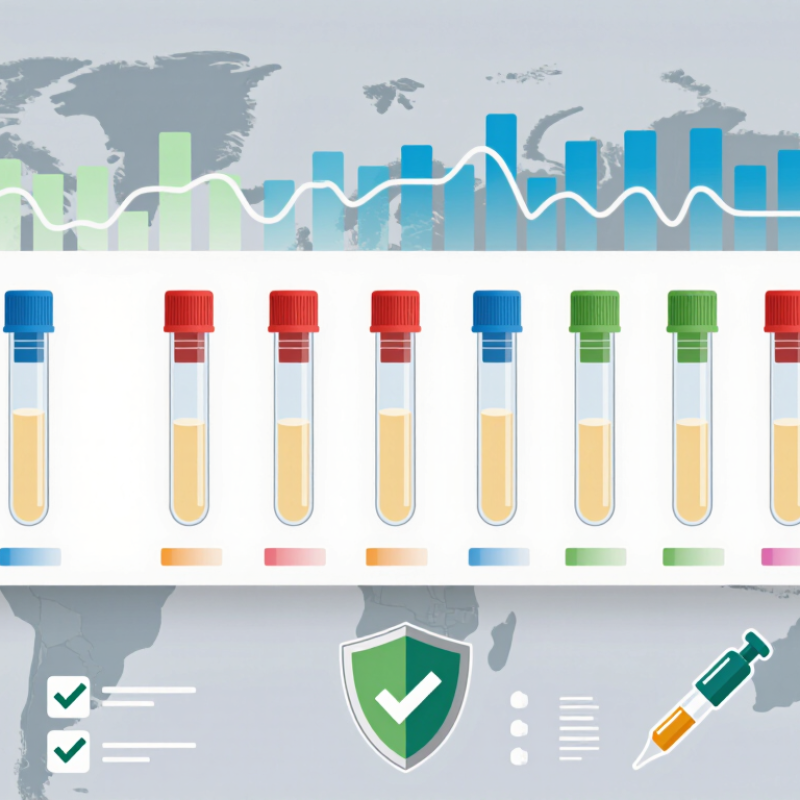
A buyer-focused framework for comparing pTau217 assay options. The percentages show illustrative evaluation priorities—not measured performance scores or a ranking of specific assays.
Compare each assay using its published validation evidence, intended-use documentation, specimen requirements, workflow details, and region-specific availability.
For global buyers in 2026, comparing blood-based pTau217 assays means looking beyond headline sensitivity. Check the sample type, analytical range, detection limits, and precision across repeated runs. A result near a decision threshold deserves particular scrutiny. Small differences can affect interpretation. Platforms also shape daily performance: automated systems may reduce hands-on steps, while manual workflows can offer flexibility for smaller laboratories. Ask for data from the exact specimen matrix you plan to use, since serum and plasma are not always interchangeable. Independent validation matters.
Availability is practical, not just technical. Confirm regional distribution, service coverage, instrument access, and expected reagent lead times before choosing an assay. Some methods may require specialized equipment or trained staff, adding cost and slowing routine testing. Compare calibration procedures and quality-control materials, too; results from different platforms should not be assumed equivalent. Evidence from diverse populations remains uneven, and that gap deserves attention. A polished brochure cannot settle it. Buyers should review intended-use claims, local requirements, and published performance data with qualified laboratory and clinical teams. A fair comparison may reveal compromises rather than one clear winner.
How to Select a pTau217 Assay for Your Laboratory or Clinical Setting
Start with the intended use: research, triage, or clinical evaluation. These settings need different evidence and decision thresholds. Check whether the assay is validated for plasma or serum, then confirm collection tubes, storage conditions, freeze-thaw limits, and interference testing. Review precision near the clinical cutoff, not only performance across a wide concentration range. Small details matter.
A 2024 JAMA study by Palmqvist and colleagues assessed blood-biomarker strategies in 1,213 people across primary and secondary care. The studied strategy achieved 90% diagnostic accuracy, compared with 73% for clinicians’ initial assessments. This is encouraging, but it does not establish equal performance for every pTau217 assay or population. That distinction is easy to miss.
Ask for independent validation, documented analytical limits, and evidence from patients resembling your own. Predictive values can shift with disease prevalence, so a cutoff developed in a specialist clinic may not transfer neatly to community testing. The 2024 Alzheimer’s Association Facts and Figures report estimated 6.9 million Americans aged 65 and older were living with Alzheimer’s dementia. Demand is real. Yet local validation still matters, and imperfect evidence should be stated plainly. No assay is magic.
A practical comparison of seven assay approaches for measuring phosphorylated tau at threonine 217 (pTau217). “Best” depends on specimen type, intended use, laboratory capability, and local regulatory requirements.
| Assay approach | Typical specimen | Where it may fit best | Practical advantages | Important limitations | Checks before selection |
|---|---|---|---|---|---|
| 1. Automated chemiluminescent immunoassay | Plasma or serum; some methods may also be configured for cerebrospinal fluid (CSF). | Clinical or high-throughput laboratories seeking automated sample processing and routine batch testing. | Automation can support consistent workflows, reduce manual handling, and accommodate higher sample volumes. | Performance is assay-specific. Automation alone does not establish clinical validity, and low-concentration plasma measurement requires suitable analytical sensitivity. | Confirm specimen-specific validation, reportable range, precision, interference testing, calibration traceability, and regulatory status in the intended country. |
| 2. Electrochemiluminescence immunoassay | Commonly evaluated with plasma or CSF, depending on assay design. | Research or laboratory-developed workflows needing sensitive immunodetection and flexible assay development. | Electrochemiluminescent detection can provide a broad analytical range in appropriately optimized assays; some formats support multiplexing. | Antibody pair, matrix effects, and assay configuration affect results. Multiplex performance must be validated rather than assumed to match a single-plex assay. | Review lower limit of quantification, dilution linearity, recovery, cross-reactivity with related tau forms, and comparability across reagent lots. |
| 3. Digital single-molecule immunoassay | Primarily plasma or serum in research workflows; CSF may also be assessed. | Studies where very low analyte concentrations or small sample volumes are a concern. | Digital counting approaches can achieve high analytical sensitivity when the assay is properly developed and validated. | High sensitivity does not by itself guarantee clinical accuracy. Results can be affected by platform-specific calibration, sample handling, and between-laboratory differences. | Check quantification limits in the actual specimen matrix, precision near clinical decision points, dilution requirements, and availability of reference materials. |
| 4. Plate-based enzyme-linked immunosorbent assay (ELISA) | CSF and, for suitably sensitive and validated methods, plasma or serum. | Research laboratories needing a familiar plate-based workflow and moderate sample throughput. | Uses established immunoassay procedures and standard laboratory equipment; can be practical for small-to-medium research batches. | Manual steps may increase hands-on time and variability. Conventional formats may not provide adequate sensitivity for every plasma pTau217 application. | Verify matrix-specific sensitivity, duplicate acceptance criteria, plate-to-plate controls, sample stability, and validated operating procedures. |
| 5. Immunoprecipitation followed by LC-MS/MS | Typically plasma or CSF, with enrichment and sample preparation adapted to the target peptide. | Specialist laboratories seeking orthogonal confirmation or a mass-spectrometric measurement of pTau217-related peptides. | Mass spectrometry can distinguish target peptides by mass and fragmentation; enrichment can help address low abundance in complex samples. | Requires specialized instrumentation, trained staff, and careful control of enrichment recovery. Method development and turnaround may be more demanding than routine immunoassays. | Assess peptide coverage, enrichment recovery, internal standards, interference control, analytical sensitivity, and inter-laboratory reproducibility. |
| 6. Targeted LC-MS/MS without immunoenrichment | Most suitable where the target peptide is present at measurable levels; feasibility depends on specimen and method sensitivity. | Analytical laboratories with mass-spectrometry expertise conducting method development or peptide-level studies. | Provides a direct peptide-based measurement and can support characterization of phosphorylated and non-phosphorylated peptide forms when the method is designed to do so. | Low-abundance pTau217 in blood can be challenging to quantify without enrichment. Sensitivity, selectivity, and recovery need to be demonstrated for each matrix. | Confirm limits of quantification, use of appropriate isotope-labelled internal standards, chromatographic separation, and validation in the intended specimen type. |
| 7. Multiplex immunoassay including pTau217 | Usually plasma, serum, or CSF as specified by the validated panel. | Research studies measuring pTau217 alongside other neurological or inflammatory biomarkers from the same sample. | Can reduce sample-volume needs and provide multiple biomarker measurements within one workflow. | Panel inclusion does not guarantee equivalent performance for every analyte. Cross-reactivity, matrix effects, and multiplex-specific calibration can affect results. | Review pTau217-specific validation data, single-plex versus multiplex agreement, analyte interference, and whether the panel is intended for research or clinical use. |
Selection note: These are assay-method categories, not named commercial products or a claim that all formats are available as validated clinical tests in every market. Compare methods using the intended specimen, analytical validation, quality-control materials, local regulatory status, and clinical-use requirements. Do not treat results from different assay methods as interchangeable without a suitable comparability study.
*The content on this website is for general informational purposes only and should not be taken as medical advice. Please contact your physician or therapist to learn what therapy solution is suitable for your specific needs. Not all products, features, or indications shown are approved in all countries.